
On March 11th, I rose to introduce my private member’s bill C-264, which I am calling The Oil Tanker Moratorium Repeal Act. This new bill will, if passed, repeal Bill C-48, a law passed during the Trudeau government, which banned oil tankers from docking anywhere on the northern coast of British Columbia.
The Prime Minister has committed his government to ensuring a new oil pipeline to Canada’s west coast is built. In its recent Memorandum of Understanding signed with the Government of Alberta, the government stated it would:
“enable the export of bitumen from a strategic deep-water port to Asian markets, including if necessary through an appropriate adjustment to the Oil Tanker Moratorium Act.” (Government of Canada, 2025).
I have long believed that Canada needs to return to building big things. Particularly with the current geopolitical situation both south of the border and in the Middle East, it is very clear that the world needs energy suppliers that can offer reliable, stable production of oil and gas products together with a record of strong environmental stewardship. In my work as a member of the House of Commons Standing Committee on International Trade, and in my travels on trade missions to Mexico and to Singapore, the ask has been made abundantly clear. The world needs more Canadian energy.
We know, however, that a new pipeline won’t be built without ships at the end of the pipe to carry our oil and gas products to new markets. We need to be able to dock a greater number of tankers on the BC coast in order to move our products, and we need to be able to do this safely. In examining how we might do this, it became increasingly obvious to me that either amendments to the moratorium, or its outright repeal, would be required.
As I reviewed the moratorium and its related scientific rationale to determine how to proceed, it became clear to me that the ban has never been founded in science, or practicality, or even a genuine desire to protect the environment. In the result, it is clear that it must go. I am sure many of you agree with that conclusion immediately upon reading it. For those that are less certain, I offer you the following analysis of why the moratorium is simply wrong.
Zero Serious Spills
When the tanker ban was put in place, the argument was that it was necessary to protect the environment. But that argument is completely inconsistent with the reality of commercial shipping on Canada’s west coast. Nearly a century of tanker traffic has sailed the west coast without a serious oil spill of Canadian crude oil (Morgan, 2017). Tankers are statistically safer than cars, airplanes, trains and even oil pipelines when looking at the number of shipments safely transported (Council of Canadian Academies, 2014). Right now the Port of Vancouver loads roughly 400 oil tankers each year and there have been zero spills. Our safety standards are world-class and our record proves it.
Existing West Coast Tanker Traffic
Speaking of shipping safety, the Liberal tanker ban only prevents loading and unloading of oil tankers on the northern BC coast (Transport Canada, 2019). It does not prevent tanker traffic from going up and down our west coast – and many tankers do exactly that. More than 200 shipments from Alaska annually sail down the west coast, safely delivering more than 80 million barrels per year of Alaskan crude oil to US ports on the west coast (ConocoPhillips, n.d.)
The Hecate Strait
Some have argued that the tanker ban is required to protect the Hecate Strait because it’s difficult to navigate. This argument seems to be based on conjecture, and perhaps a few old sea stories. There are no Transport Canada risk analyses that describe the Strait as particularly challenging (Warren, 2025). BC passenger ferries travel through the Strait on a regular basis (BC Ferries, 2026).
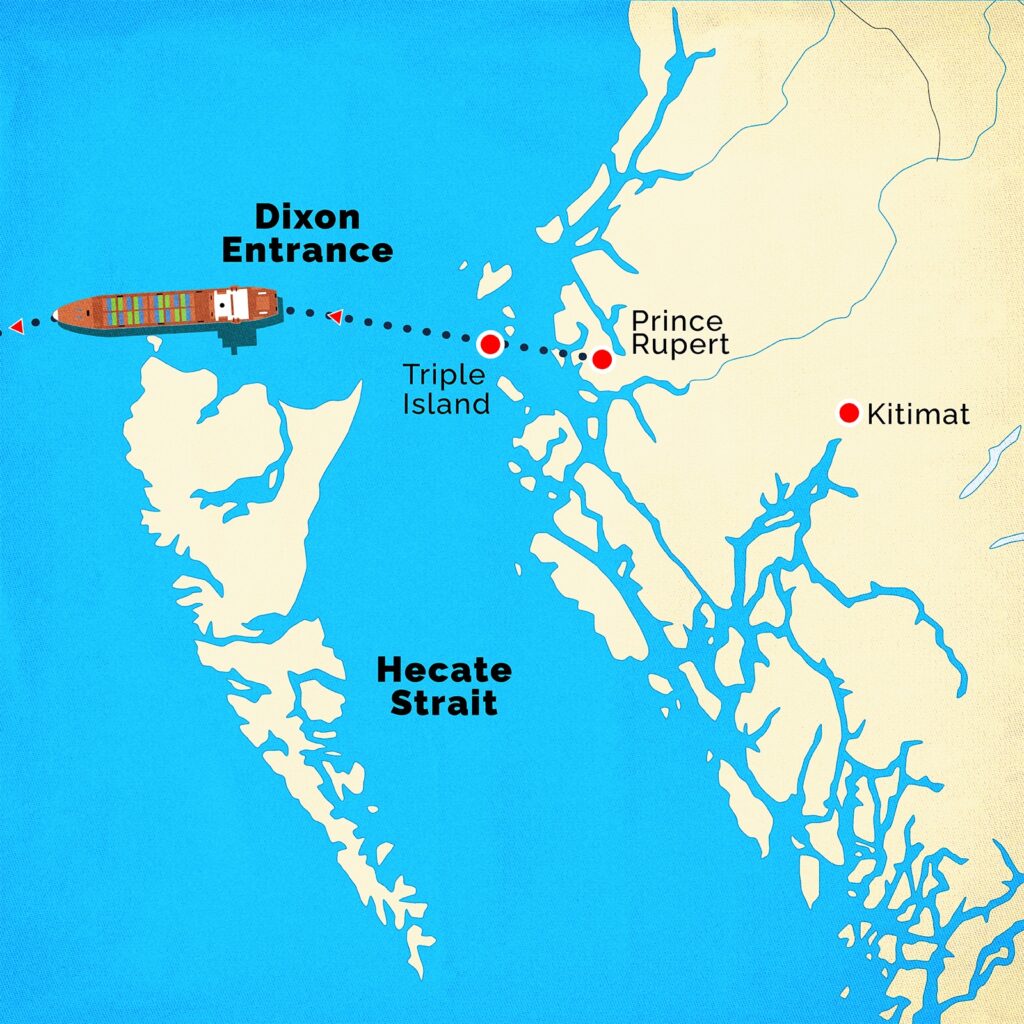
Keep in mind that oil tankers don’t even need to pass through the Hecate Strait to transport crude oil from the Prince Rupert port. For Asian ports, transiting the Hecate Strait is not the most direct route. Rather, ships headed to international ports would sail north through the Dixon Entrance and into the open ocean (Chin, 2025).
Additional Ports Reduces Risk
Marine accidents can and do happen, but the most common causes are ship collisions and groundings (International Tanker Owners Pollution Federation, 2023). These accidents, logically, tend to happen when ships are near ports, and particularly when the ports are congested. The Port of Vancouver currently suffers from congestion issues and aging infrastructure, and the Trans Mountain Pipeline expansion has already increased tanker traffic there (House of Commons Standing Committee on International Trade, 2024). Additional port capacity at Prince Rupert and Kitimat can reduce the pressure on the Port of Vancouver and increase shipping safety.
No Moratorium on the East Coast
Every year roughly 240 tanker trips move crude oil on the St. Lawrence River between storage in Montreal and refining facilities outside of Quebec City (Clear Seas, 2025). In Newfoundland and Labrador, about 90 oil tankers visit the Whiffen Head facility every year to load crude oil (Clear Seas, 2025).
What is the logical reason why oil tankers can sail safely down the St. Lawrence River, can safely sail the coastal waters of the Maritimes, can crowd into the Port of Vancouver but can’t dock in Prince Rupert? What is the logical reason why tankers can deliver oil in Newfoundland but can’t load in Kitimat? The more I examined the evidence, the more I came to the conclusion that there is no logical reason. The Liberal tanker ban was always about shutting down western oil production. It was never about safety or environmental protection.
Modern Oil Tankers are Extremely Safe
Today’s tanker fleet is double hulled (International Maritime Association, 2023), sails using GPS navigation technology, is extensively monitored and when close to shore requires escort tugs and marine pilots specifically trained on the waters those ships are in (Transport Canada, 2023). Tankers, and commercial shipping, are very safe.
Conclusion
The Oil Tanker Moratorium blocked energy development projects in Canada and effectively ended the Northern Gateway pipeline and the Indigenous-owned Eagle Spirit Energy project. What has become very clear in my research is that there is no justifiable rationale for the moratorium other than to block energy developments. Even if, for argument’s sake, one weighs the environmental risks associated with tanker traffic (which are not zero but certainly are about as close to zero as one can get) heavily, there is no justification for western traffic to be blocked while eastern traffic sails moratorium free. The moratorium is a policy decision based upon virtue signalling and not science.
If projects like Northern Gateway and Eagle Spirit had been allowed to move forward, Canada would already be on its way to providing energy security to countries like South Korea, Japan and India, and not just talking about doing it. Our energy industry is world-leading in advanced technologies, environmental safety and impact, creates thousands of high-paying jobs and fosters real economic reconciliation with Indigenous communities: the industry deserves our support. In this time of global uncertainty, the world needs more Canada and more Canadian oil and gas.
Our Conservative Caucus has supported the government in its efforts to get major projects moving in Canada. Part of that was voting for Bill C-5, which enabled the establishment of the Major Projects Office and gave cabinet discretion to exempt projects in the national interest from things like the tanker moratorium. We felt that, in the interest of expediency, it was appropriate to allow for a temporary override. We still believe it is essential that the hard work – to repeal the underlying legislation blocking major projects – needs to be done. My bill focuses on a piece of that puzzle.
The Oil Tanker Moratorium Repeal Act will be up for debate in the months ahead. You can expect our team to keep our attention on the facts and the science, which I have tried to lay out here in detail for you. I challenge my colleagues in all corners of the House to do the same. Let’s focus our discussion on how we can offer more of Canada to the world, how we can create energy security for other countries, and how we can continue to build prosperity at home.